How to Choose Kids Play Tent Size & Material | Xuyu
A wholesale buyer's guide to kids play tent size and material, with real model data, carton counts and the checks to run before you order 200 pieces.
Short answer: choose the size from the space where the tent will be used and stored, then choose the material by handling a sample — and confirm three numbers before you order: the open size, the packed size, and the pieces per carton. This guide shows you how to run those checks with real numbers from three of our own models, so you can check any supplier the same way.
Picture this: you order 200 tents from a photo, the cartons arrive, and the open tent is bigger than the shelf space you planned for it — or smaller than the children who will play in it. That is the mistake this guide prevents. It is written for wholesale buyers ordering 200 pieces or more. It is not a retail buying guide, and it will not tell you which single tent is "best" — that depends on your shelf, your customers, and your market.
Why size and material go wrong
Most bad orders do not start with a bad tent. They start with a missing number. A listing shows you a photo and one size, and you fill in the rest from habit. Three gaps cause nearly every sizing mistake we see, and each one is easy to close if you know to ask.
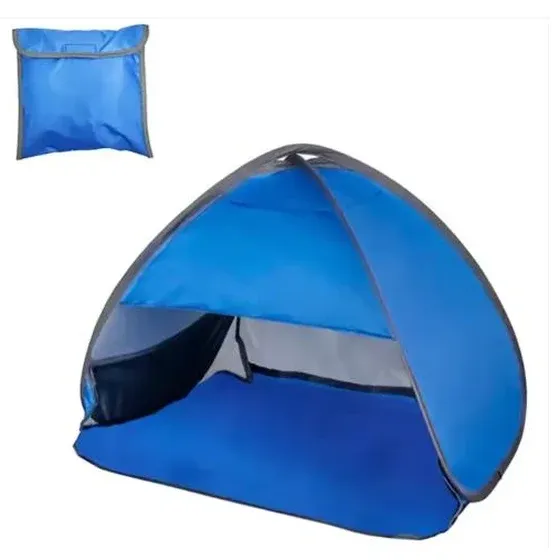
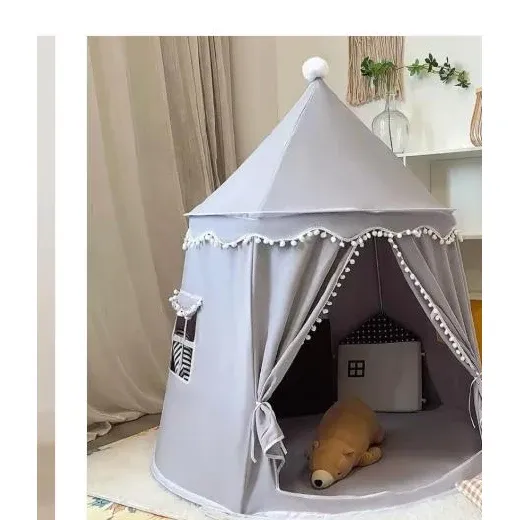
The first gap is the packed size. An open size tells you how much floor the tent covers when it is up. It tells you nothing about how it travels or stores. Our Kids Play Tent PJT-001 measures 103 by 135 centimetres open, and it ships as one tent in an individual carry bag, 20 pieces per carton. Our Kids Play House PJH-001 measures 118 by 103 by 128 centimetres, also 20 pieces per carton. The open size and the carton count are two different numbers, and a buyer who only has the first cannot plan a shelf, a warehouse slot, or a container load. Before you order, ask for the packed size of one piece and the pieces per carton, and write both next to the open size.
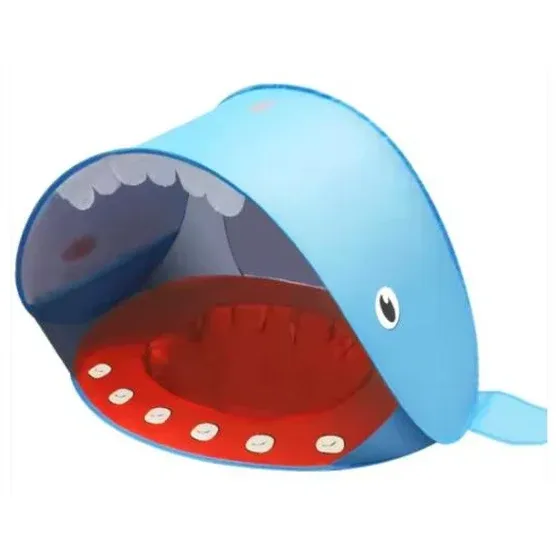
The second gap is the material name without its weight. A fabric name tells you the family, not the substance. Our range uses two fabrics: peach skin fabric and 190T polyester. PJT-001 is listed as thickened polyester fabric, peach skin and 190T polyester. PJH-001 is peach skin fabric. PJS-001, the Elephant Tunnel Set, is 190T polyester. The "190T" is a thread-count figure — a higher T generally means a tighter weave — but it is not a weight, and neither is "peach skin". What you need, and what a spec sheet often leaves out, is the fabric weight in grams per square metre, whether the fabric has any coating, and how it is cleaned. Our own spec sheets do not publish those three figures, so we say so plainly here: ask for them at quote stage, and judge the material by handling a stock sample, not by the name on the listing.
The third gap is the missing age and height guide. A tent that is right for a three-year-old is a squeeze for a six-year-old, and no photo will tell you which child fits. Our spec sheets give exact dimensions but no age range, and we will not invent one. The honest way to close this gap is to measure the open size against the children you sell to: a 103 by 135 centimetre tent gives about 1.4 square metres of floor, a 118 by 103 centimetre play house gives a little more, and the Elephant Tunnel Set runs 220 centimetres long in total, which needs a clear two-metre run of floor. If you sell to a known age group, tell your supplier the ages and ask them to confirm the fit — and test it with a stock sample before you commit to 200 pieces.
How to decide: size first, then material
Decide in this order. Size first, because size decides whether the tent fits your space at all. Material second, because material decides how it feels, packs, and lasts — and you can only judge that by handling it.
- Measure where the tent will be used and stored. Write down the floor space where it will stand open and the shelf or carton space where it will be stored. Do this before you look at models, not after.
- Match the open size to that space. PJT-001 at 103 by 135 centimetres fits a small play corner. PJH-001 at 118 by 103 by 128 centimetres needs a little more floor and 128 centimetres of height clearance. PJS-001 is a different shape altogether: the elephant tent is 100 by 86 by 101 centimetres and the play tunnel adds 45 by 120 centimetres, for 220 by 86 by 101 centimetres in total. If your floor cannot take a 2.2 metre run, the tunnel set is the wrong shape no matter how good it looks.
- Check the packed size and the carton count. PJT-001 and PJH-001 both pack 20 pieces per carton, one tent per individual carry bag. For PJS-001 the carton quantity is not published on our spec sheet — that is exactly the kind of number to ask for before you order, because it decides your freight and your storage. Never place a 200-piece order while the carton count is still blank.
- Choose the material by handling a sample. Stock samples are free of charge, and custom samples are accepted. For the Elephant Tunnel Set PJS-001, the delivery freight of the stock sample is paid by the customer. Order the sample, open it, fold it, pack it back into its carry bag, and let the children it is made for try it. A sample tells you more about a fabric in ten minutes than a fabric name tells you in a week.
- Confirm the commercial terms in the same message as the technical ones. Across our three models the terms are the same: minimum order quantity 200 pieces, delivery time 30 to 45 days, two-year quality warranty, goods shipping from Ningbo or Shanghai, origin Zhejiang, China. Confirm them in writing with your order, and confirm the payment terms at quote stage — we do not publish a payment method on the listing, and you should not assume one.
What to verify before you pay
A sample-first order still needs a short verification pass, and the things to verify are the things no listing can prove.
First, do not order a full 200-piece run from a photo alone. The stock sample exists for this reason: it is free of charge, and it is the cheapest way to find out that a size or a fabric does not suit your market. One sample can stop a 200-piece mistake.
Second, do not assume one material fits every market. Peach skin fabric and 190T polyester are both used for indoor and outdoor play in our range, so neither one is "the indoor fabric" or "the outdoor fabric". What differs by market is labelling, care instructions, and safety requirements — check your own market's rules and ask your supplier for the documents that market asks for. Our factory is BSCI and ISO certificated; the certificate numbers are not published on the listing, so ask for copies at quote stage if your market needs them on file.
Third, do not assume the numbers you were not given. Weight is not published for these three models, the carton quantity is not published for PJS-001, and the payment method is not published at all. None of those is a reason not to order — they are reasons to ask before you pay. A supplier who answers those three questions in writing is a supplier you can plan around; a supplier who will not answer them is a risk you do not need to take.
This guide covers size and material only. It does not cover pricing, because we do not publish prices on the listing, and it does not cover freight cost, because freight is confirmed at quote stage. If a guide promises you an exact landed cost from a size chart alone, it is guessing.
Your next step
Here is the order of action. First, measure your space and write down the ages you sell to. Second, pick the two or three models whose open size fits that space — the three in this guide are a starting point, not the whole range. Third, send us a quote request with the model, the quantity, your target market, and your timeline, and ask for the three numbers this guide names: the packed size, the pieces per carton, and the fabric weight.
Your main next step is a quote request: use the Get a Quote button and include the model, quantity, target market, and timeline, and we will reply by email. If you are not ready to request a quote, the low-threshold step is the self-check above — measure your space, list your top three models, and request a stock sample of one. And if the form does not suit you, the fallback is direct email: write to sales@xuyutents.com with the same details, and keep a copy of the spec sheet with your order so the size, material, and carton count you agreed are on record.
Buyer questions
What is the minimum order quantity?
MOQ is 200 pieces.
Can I get a sample?
Stock samples are free of charge, and custom samples are accepted. For the Elephant Tunnel Set PJS-001, delivery freight of the stock sample is paid by the customer.
How long is the delivery time?
30 to 45 days.